

UNIT-1: Chapter-3
FORCES AND MOVEMENT
Forces Acting on Falling Objects
* Initially the air resistance is very small. There is a downwards unbalanced force and the skydiver accelerates.
* As the skydiver speeds up, the air resistance increases.
* Eventually the air resistance balances the weight and so the skydiver travels at a constant speed – terminal velocity.
* When the parachute is opened the increase air resistance on the parachute creates an upwards unbalanced force, making the parachuting the slow down.
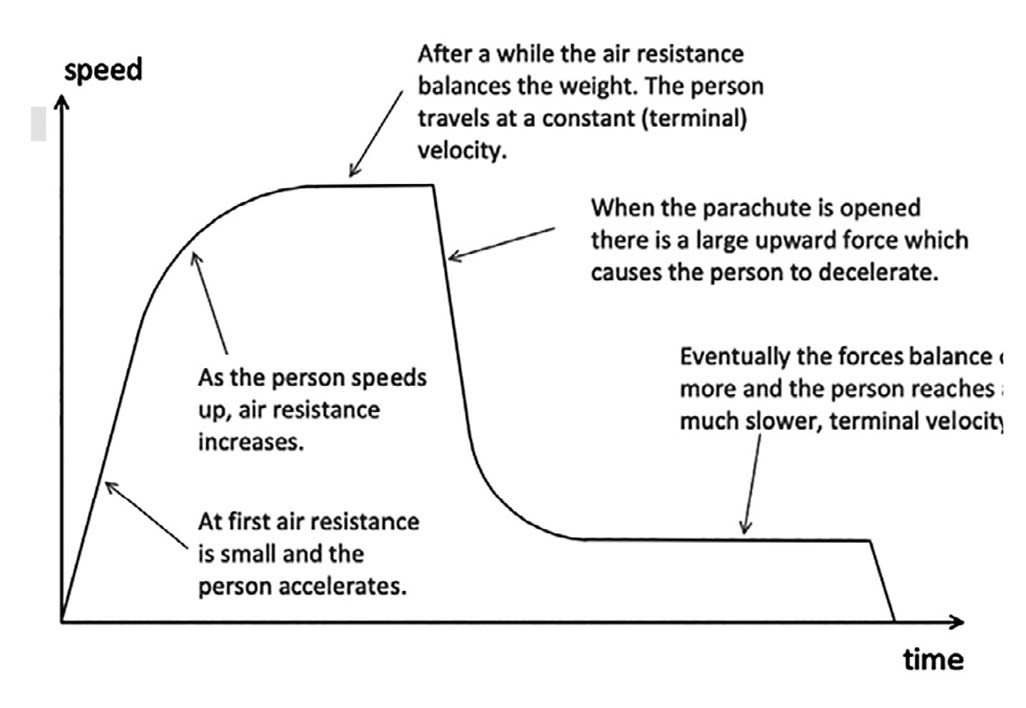
Graph showing how the velocity of a skydiver changes during the descent
Exam Tip
* The force of gravity on an object is called weight.
* If asked to name this force make sure you use this word: don’t refer to it as “gravity” as this term could also mean gravitational field strength and so would probably be marked wrong.
* Likewise, refer to the upward force as air resistance or drag.
* The terms wind resistance and air pressure mean different things and so would also be marked wrong.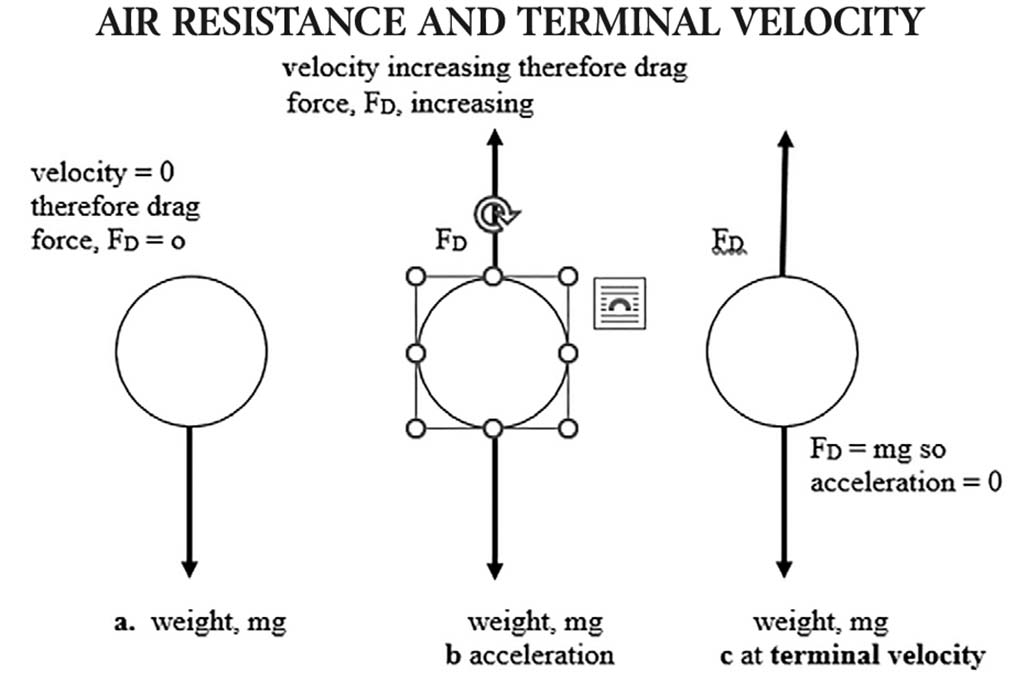
Figure 3.3 How the forces acting on an object change as its velocity changes
In Figure 3.3a the object has just been released and has a starting velocity of 0 m/s. This means that there is no drag. (Remember that the drag force acts on moving objects.) The resulting downward- acting force is just the weight force. This force makes the object acceleration towards the Earth.
Figure 3.3b shows the object now moving. Because it is moving it has a drag force, FD, acting on it. The drag force acts upwards (up) against the movement. This means that the resulting downward force (acting down) on the object is (mg-FD). You can see that the drag force has made the resulting downward force smaller, so the acceleration is smaller. All the time that the object is acceleration it is getting faster. The faster the object moves the bigger the drag force is.
In Figure 3.3c the drag force has increased to the point where it exactly balances the weight force-since there is now no unbalanced force on the object its acceleration is also zero. The object has reached its terminal velocity and although it is still falling it will not get any faster. Figure 3.4 shows a velocity-time graph for an object falling through air and reaching terminal velocity.
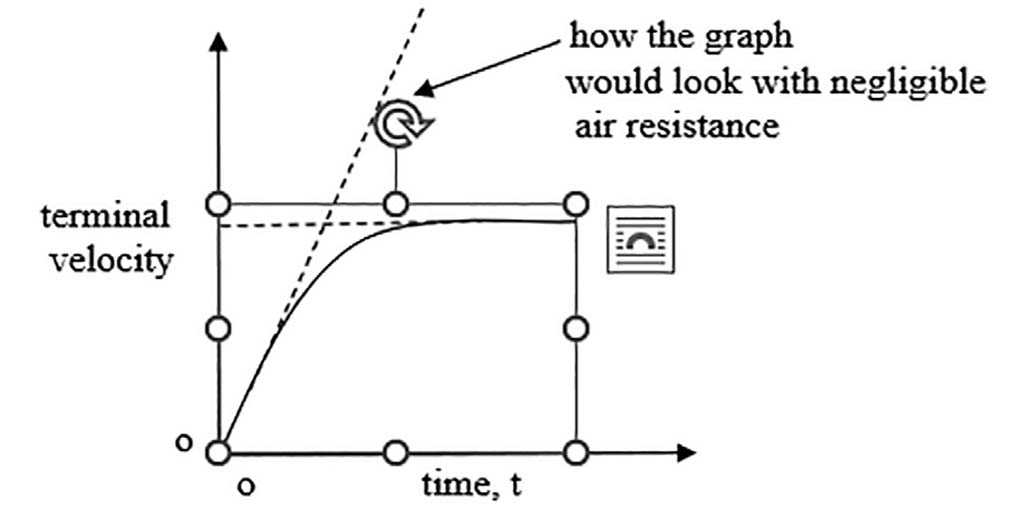
Figure 3.4 The velocity-time graph for an object acceleration until it riches terminal velocity
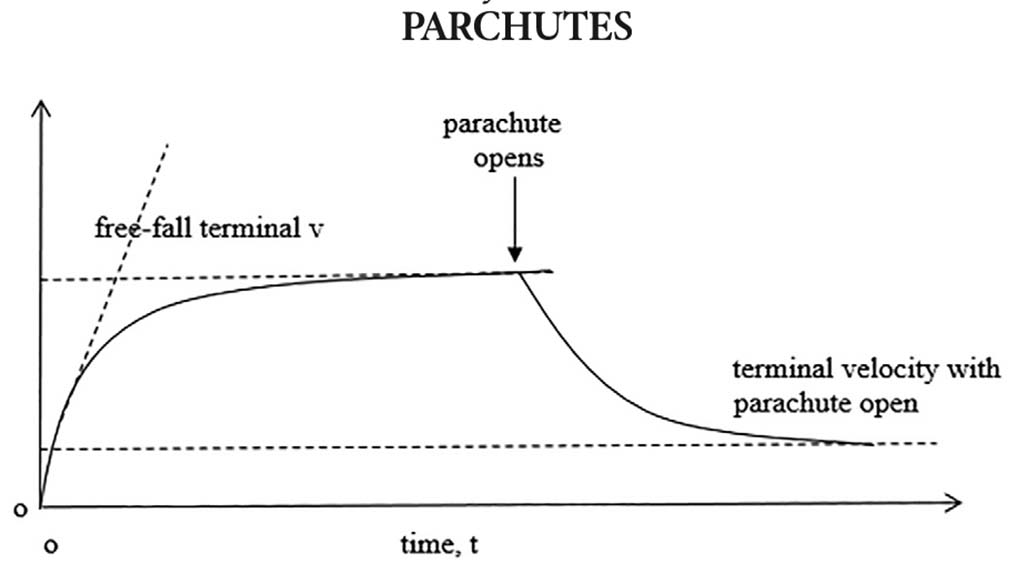
When a skydiver jumps from a plane she will accelerate for a time and eventually reach terminal velocity. She opens her parachute this will cause a sudden increase in the drug force. At this velocity the drug force of the parachute is greater than the weight of the sky driver. This means that the unbalanced force acting on the parachutist acts upward and, for a while, she will decelerate. As she slows down the size of the drag force decreases and, eventually, a new terminal velocity is reached, obviously the new terminal velocity depends on the design of the parachute, but it must be slow enough to allow the parachutist to land safely.
WORK EXAMPLE 3.1
A car travelling at 20 m/s collides with a stationary lorry and stops completely in just 0.02 s. Calculate the deceleration of the car.
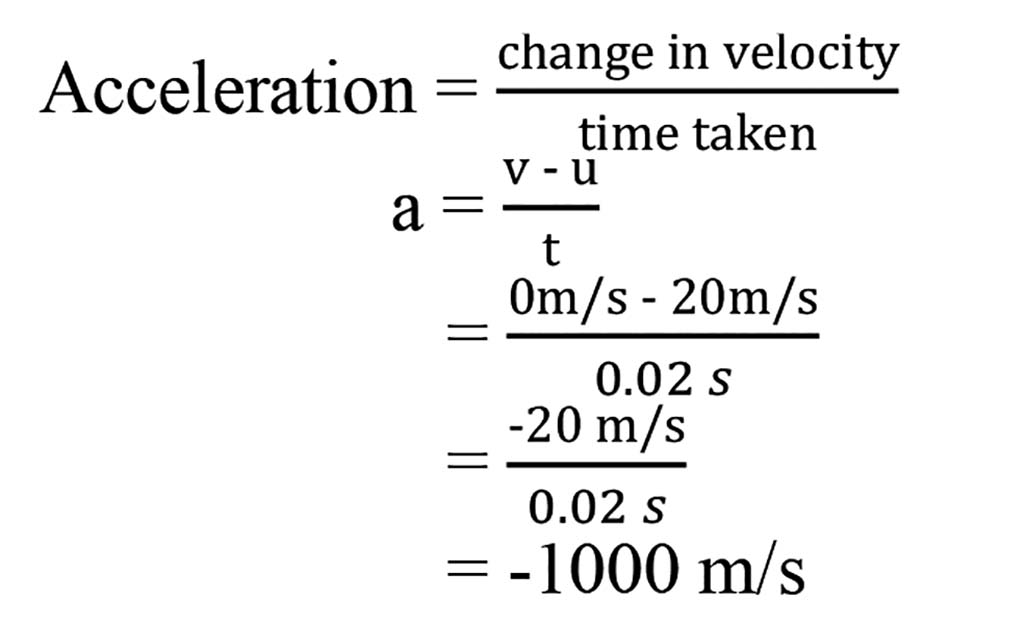
A person of mass 50 kg in the car experiences the same deceleration when she comes into contact with a hard surface in the car. This could be the dashboard or the windscreen. Calculate the force that the person experiences.
F = m × a
= 50 kg × 1000 ms-2
= 50 000 N
In Chapter you will learn about ways in which cars can be designed to reduce the forces on passengers in an accident.
লেখক:
Assistant Teacher (Senior section)
O and A level Physics Teacher
Bangladesh International School and College, Dhaka.
জাহ্নবী


